


Also, Transport for London has also just announced new public consultation over Crossrail 2.

This is the Euston-St Pancras station, with two entrances:

 |
| Wonder what that map shows! |
|
| Wonder what that map shows! |
 |
| Link to web site |
"At the moment you only go to Paddington for two reasons — to catch a train or to see someone in hospital. It is soulless and has no life and yet it is only five minutes from Hyde Park and seven or eight minutes from Marble Arch.
It is a fantastic location but it is stuck in a Fifties time-warp. We intend to create a place for people to go, where they will want to live, work, eat and shop."


| Reference number | PP/2015/4551 | |
| Application Type | OPDC EIA Development 16wk | |
| Site Address | (The Perfume Factory) 140 WALES FARM ROAD ACTON LONDON W3 6UG |
|
| Description | Outline planning application (matters of access only to be determined at this stage with all other matters reserved) for the demolition of all buildings and the retention of the existing north west façade on the northern building; construction of 5 No. residential buildings between 3 and 33 storeys (plus plant) to provide up to 534 units (mix of studio, 1 bed, 2 bed, 3 bed flats and 4 bed houses); construction of 2 No. commercial/live work buildings between 3 and 6 storeys (plus plant); to provide up to (Gross External Floor Area) 6,147 sqm Class B1/live work; and 2,175 sqm Class B1; and 1,381 sqm Class A1/Class A3; and 548 sqm Class A1/Class A3/residential; and 564 sqm Class D1 nursery; together with amenity, landscaping, car and cycle parking, access, plant and servicing | |
| Ward | East Acton | |
| Received Date | 27/08/2015 | |
| Valid Date | 28/08/2015 | |
| Decision | PENDING | |
| Decision Date | ||
| Statutory determination Date | 17/12/2015 | |
| Consultation Start Date | 11/09/2015 | |
| Consultation End Date | 02/10/2015 | |
| Case Officer | Paul Ricketts | |
| Agent Name | Miss Tanya Jordan | |
| Agent Address | 140 London Wall London EC2Y 5DN | |
| Applicant Name | Mr Barry Coltrini | |


 |
| Old Oak Common Lane Station square (yes, that is the electrified Dudding Hill Line!) |

"... On the issue of modal choice, the findings are striking in demonstrating that economic factors still remain a strong determinant of travel choice, with younger people especially concerned about the high cost of using a car relative to their income, including issues such as insurance, parking and learning to drive. The impact of concessionary and advance fares on public transport use is also an important driver, especially for younger people and pensioners. At the same time, location appears to be a key determinant for modal choice, due to the poor provision of public transport in rural areas. This is particularly the case with older people in rural areas who feel that they need to retain a car in order to preserve their independence.
"Modal choice also varies significantly across the different groups. The research demonstrates that young people are ‘falling out of love’ with the car, and place greater weight on alternative consumer products, while older people see the car as an important part of their lifestyle. At the same time, improvements in the accessibility of the public transport system are encouraging car owners to make more varied modal choices.
"... At the core of this research has been the desire to understand whether these attitudes are temporary or permanent features affecting travel behaviour. By comparing different age groups, it has been possible to see that there remain ‘tipping points’ in peoples’ lives at which point modal choice shifts. Such tipping points include starting a family, now more common in one’s 30s, at which point car ownership becomes more desirable; and also retirement, which often results in downsizing from a two to one car household.
"In spite of these factors, it is evident that across all groups we are seeing a rise in utilitarian attitudes towards car travel, which indicates that car ownership is likely to increasingly shift towards new forms of car access, such as car hire and car clubs. An equally significant factor pointing towards more permanent changes in attitudes is the way in which use of public transport modes when young increases the likelihood of continuing to use these later in life."
 |
| Link to web site |

"The principle objective of the OPDC is to establish a single body which possesses the necessary planning powers to co-ordinate regeneration, development and physical transformation across three London boroughs: Brent, Ealing and Hammersmith and Fulham. It is the mayor’s intention that this will be achieved through a strong plan, clear direction and governance structure that will support this scale of development for the benefit of the area and the communities that surround it.
"The OPDC is a functional mayoral body, however, as an MDC it is directly accountable to Londoners through an independent board. A team of officers report to a chief executive officer who is responsible for driving forward the comprehensive regeneration of this area.
"The OPDC is also a local planning authority, and its planning committee ensures decisions are made in an open, transparent and impartial manner. As part of that role, the OPDC is also responsible for the preparation of planning policy for the area, has compulsory purchase powers which it can use to facilitate this comprehensive regeneration, and can raise funds through the community infrastructure levy and section 106 agreements to support infrastructure delivery. The OPDC operates as a single voice across the three London boroughs and has been able to take part in lengthy discussions with central government to inform the Spending Review 2015 and the forthcoming Autumn Statement. Having a single organisation to drive the regeneration of the area gives greater certainty over planning and co-ordination, decision-making and investment.
"The mayor’s purpose in creating the OPDC is to provide clear leadership and co-ordination for this significant regeneration project, and to act as a single point of contact for the local residential and business communities, developers, investors, landowners and transport agencies. The OPDC has to build its reputation and credibility quickly so that it adds value to local development efforts, fostering a comprehensive and co-ordinated approach to land pooling, infrastructure delivery and masterplanning of the area by public and private sector landowners, developers, and a wide range of different stakeholders, to unlock the full potential of the area. By taking on such a task, the OPDC assumes a great deal of reputational risk."
"The LLDC was the first MDC, covering the Olympic Park and surrounding area and spanning four boroughs, and has been tremendously successful in regenerating east London. However, the LLDC was in the privileged position of owning a large portion of the development land in the area and had the Olympics as a catalyst, which helped to capture people’s imagination. It is important to consider how best to do this at Old Oak Common and Park Royal.
"The OPDC has to have a plan, drive ownership forward and ensure that there is public and private 'buy-in'. The first two years will be crucial for building a strong vision and compelling proposition for the area that gives government, the private sector, and investors the confidence to invest in the infrastructure necessary to unlock development.
"It will be important to engage existing communities in early activation activities to give them a strong sense of ownership of the emerging local plan and new neighbourhood, and give prospective new arrivals the confidence to make it their location of choice.
"The OPDC will create the foundations for transformational change through robust planning and regeneration policy and transparent governance arrangements that provide clear and consistent leadership and incentives for key stakeholders to collaborate; alongside a robust delivery programme that sets out where, and when, development will take place.
"There are other examples of successful regeneration programmes that captured the people’s imagination such as King’s Cross, where Network Rail, London & Continental Railways and Argent achieved this by attracting cultural, educational and iconic uses to the area. There are opportunities to learn from this. Planning for the longer term is important and there needs to be flexibility. However, there is also a need to build confidence and demonstrate momentum by identifying and delivering 'quick wins' to secure buy-in for the regeneration of Old Oak Common and Park Royal."
"In the 1980s, in an effort to reverse the process of inner city decline, the government set up Urban Development Corporations (UDCs). The aim was to regenerate areas that contained large amounts of derelict land by taking over planning responsibility from local councils. They had the power to acquire land, clear it and then provide infrastructure.
"They also attracted investment from the private sector by offering companies reduced taxes and other benefits and, in doing so, they promoted industrial, residential and community developments. However, they needed upfront funding to build the infrastructure and housing which could later be sold at a profit. Treasury guarantees were essential for UDCs.
"Some people see UDCs as agents of central government, imposed on local areas and denying local authorities of their normal rights and planning powers. However, the historic UDC model can be easily strengthened to make it more democratically accountable through allowing local authorities to create, and effectively own, the UDC, appointing their board and providing the operating brief. Locally based UDCs could become the contractual partner for landowners and infrastructure providers, providing transparency, clarity and greater confidence all round and helping to deliver the homes and jobs that the nation so desperately needs.
"Such transformations can already be seen in MDCs where there is accountability and, indeed, the OPDC is going one step further by ensuring the local authorities, local residents and local businesses are represented on the OPDC board and planning committee.
"These members will have a decision-making role in setting and adopting planning policy, setting CIL and determining planning applications. MDCs are also able to influence the land, whether through their sole ownership, use of compulsory purchase powers, co-ordinated delivery or the use of special delivery vehicles.
"The UDCs have played a central role in informing this learning process, both through their successes and failures. This has been done by demonstrating the importance of developing partnerships across local public and private stakeholders; the key facilitating role that local authorities can play as accountable long-term local stakeholders; and the importance of co-ordinating expenditure and programmes across the economic, environmental and social domains of regeneration.
"What the UDCs also clearly achieved was to help in the process of altering the context in which physical regeneration was tackled. Their introduction of a more single-minded and commercially sensitive approach to physical renewal attracted private sector involvement and investment into areas from which resources had previously been progressively withdrawn. This was an important spur to prompt the private sector and local authorities and other public-sector bodies to work more collaboratively.
"Large-scale development requires serious long-term commitment that can span political and economic cycles and a dedicated delivery vehicle to see it through the rocky road to completion: whether it is an MDC or a UDC. The London Docklands, east London and London Thames Gateway are different places today not only because of the often dramatic physical renewal within their areas, but because of the wider and more informed interpretation of regeneration that has in part stemmed from the inheritance of the UDC experience and in some cases the MDC."

 |
| Link to web site |
"Slough council is opposing government plans to build a depot for Heathrow Express trains in Langley.
"The High Speed 2 (HS2) project includes a bill which proposes moving the depot from Old Oak Common in London to an area north east of Langley.
"Slough Borough Council has now submitted a petition against the bill citing concerns over air quality, loss of land for housing and road access."

"We've got serious concerns about the impact of the depot, both while it's being constructed and when it becomes fully operational.
Major issues like road access, air quality and the loss of land earmarked for much-needed family housing have not been properly considered, and no details have been given on how the effects would be mitigated.
Businesses might decide not to invest in the area, and the move could affect plans to build a western rail link to Heathrow."
"It is important that all parties who feel they may be affected by the construction and operation of HS2 are able to petition.
These petitions will now be considered by the select committee as part of the hybrid bill parliamentary process."

 |
| Link to web site |
"Developers leading the multi-million pound transformation of land around Wembley stadium have unveiled plans for a series of high-rise office blocks aimed at drawing City workers and tech start-ups to the area.
"At a glitzy reception at the Hilton Sky Bar in Lakeside Way, developer Quintain revealed it is releasing 750,000 square feet of land to make way for four eight to nine storey blocks of dedicated office space.
"... Sarah O’Connell, Director of National Offices at Colliers International said:
"Wembley really does have everything in place to be the next King's Cross.
With everything already here, employees would have access to three stations, 76 shops and 20 restaurants, as well as a 9-screen cinema and the world famous sports stadium."

"HS2 Ltd says services will not start from Old Oak Common, despite Transport Minister Robert Goodwill suggesting that they could do so for 'several years' while London Euston is redeveloped.
"Goodwill was quoted in the Telegraph on September 19 as saying: 'We are considering whether to open the service to Old Oak Common a few months early and push back the completion of Euston for a few years.'
"However, HS2's plans to redevelop Euston in two stages - six new platforms and concourse to support Phase 1 of the route from London to Birmingham by 2026, followed by another five platforms for the Phase 2 extension to Manchester and Leeds by 2033 - remain as stated (RAIL 783).
HS2 spokesman Ben Ruse told RAIL: 'The Government's plan remains to open Phase 1 from Euston to Birmingham in 2026. If possible, we will open earlier than that, but that will depend on progress with the Hybrid Bill and preparatory works. There is no intention to delay the opening of Euston station as the terminus for HS2. In fact, as the Bill before the House sets out, the intention remains to open all of HS2 Phase 1 in one go.'
"Goodwill suggested that changing from HS2 to Crossrail at Old Oak Common would save passengers time compared with using conventional services to Euston, but RAIL understands that should services terminate at Old Oak Common, there would be serious repercussions for Crossrail.
"With up to 1,000 passengers per train switching from HS2 trains to Crossrail at Old Oak Common, Crossrail trains could be full to capacity before entering central London - the area where the commuter route's extra capacity is needed most.
"HS2 submitted detailed plans for the redevelopment of Euston in September. At the time, Secretary of State for Transport Patrick McLoughlin described them as 'a vital piece of infrastructure that will benefit the whole nation'."

1) Did the DfT insist to HS2 Ltd. there had to be three reversing sidings at Old Oak Common? Whose analysis concluded that the original two sidings between the WCML relief lines were inadequate?
"The requirement for three turnbacks emerged from an operational analysis of the train service specification."
2) Where does the DfT anticipate the three sidings might be extended to? The top two to the WCML? The other one to the Wycombe Line (Acton-Northolt)? Was the latter just for a daily Parliamentary train? Why wasn’t a grade-separated junction between the WCML and the Wycombe Line links envisaged, given the existing available operational railway land? If the WCML link took, say, 8 tph and Wycombe took 4 tph Crossrail trains, would the DfT regard grade-separation at their junction as highly desirable?
"The provision of three sidings is to enable two to be extended as part of the WCML-Crossrail Link, if progressed, and one for turning back trains at Old Oak Common. There is no current plan to reconnect the Wycombe Line."
3) Is the DfT content that the Crossrail sidings do not quite reach the 1913 North London Line Acton Wells railway bridge? Which of the four spans (call the northernmost span number one, and increment southwards) does the DfT expect the siding extensions to use?"This bridge would have needed to be replaced."
4) Would any Crossrail-to-WCML project pay to refurbish/renew the Acton Wells Bridge? Which spans?"As the Link project is in a very early stage of development, the allocation of budget has not been decided."
5) If the WCML loop tracks passed beneath span Three, next to the Central Line, so that a grade-separated up-Wycombe Line track could pass underneath those rising and curving WCML tracks and then pass beneath span One of the bridge, would the DfT be content that all four spans had to be refurbished/replaced (no doubt with a financial contribution from TfL)?"This arrangement has not been reviewed and therefore the consequences of such an arrangement cannot be commented upon."
6) Where does the DfT expect the WCML loop tracks have to reach? Joining the Dudding Hill Line immediately south of the Victoria road railway bridge? Or over a new bridge to the west, to run towards the WCML, separate but parallel to the Dudding Hill Line tracks (to avoid timetable contamination from London Overground and slow freight trains)?"A scheme for the WCML - Crossrail Link is already in the public domain and was tabled at an information event in the Old Oak Common area in 2014. The link uses the Dudding Hill Line."
7) Is the DfT aware of the Mayor of London’s aspiration to run a new London Overground service along the Dudding Hill Line, linking together London Opportunity Areas, and providing a bypass to the North Circular Road?"TfL were involved in the development of a scheme for the WCML-Crossrail Link (see above) and shared their knowledge of future aspirations."
8) Would the location of any new WCML bridge allow space for the current Dudding Hill Line to be slewed to the west, to allow station platforms to be built alongside Midland Terrace?"The scheme developed in 2014 did not allow for this eventuality."
9) Might that suggest building a new four-track railway bridge over Victoria Road, and the demolition of the existing, narrower-span bridge?"The scheme did not need to replace the existing bridge DHL Bridge over Victoria Road."
10) Is the Dft aware that there are existing unused bridge abutments, built in 1913, to allow the Acton Wells Bridge to be widened to four tracks?"HS2 are not in possession of any information to this effect."
11) Will the DfT scope out the opportunity to four-track the Acton Wells bridge, given the possibility of 8 or 12 tph of London Overground, plus freight, using the bridge in the future?
"It is too early to either scope in or scope out the four tracking of the North London Line and hence the Acton Wells bridge."
 |
| Link to PDF file |
"This paper summarises the Promoter’s analysis of a HS2 Euston Action Group (HEAG) proposal to locate the main HS2 terminus at Old Oak Common with a link to Euston for a few HS2 trains. The link would be from Old Oak Common to the West Coast Main Line (WCML) in the vicinity of Queens Park.
"The transport and train operation conclusions of this paper are:
"The Promoter remains of the view that the HEAG proposal to locate the main HS2 terminus at Old Oak Common would be contrary to the principle established at Second Reading that the London terminus should be located at Euston.
- Terminating all HS2 trains at Old Oak Common would reduce the HS2 overall patronage and the revenue by over 10% and t he economic benefits of the Phase by 15%. Patronage between London and the West Midlands would be reduced by over 20%;
- Compared with the Proposed Scheme for a terminus at Euston and an interchange at Old Oak Common the two terminus proposal would increase journey times for HS2 passengers to many parts of central, north and south London;
- When Phase 2 of HS2 is implemented, there would be insufficient capacity on Crossrail to accommodate HS2 passengers to Central London; and
- The proposal to run only a few classic compatible trains to Euston would not be capable of supporting a viable train service specification, nor justify the cost of the Euston tunnel. A 5-6 platform HS2 station at Euston would incur most of the property demolition, adverse environmental effect and cost of the Proposed Scheme, but result in a much reduced HS2 train service to Euston. There are therefore no viable two terminus options.
"Nor would there be any purpose in further consideration of the HEAG option or any two terminus solution, as none would be capable of supporting a credible operational specification, or demonstrate sufficient passenger benefits to justify the cost."
 |
| Link to PDF file |
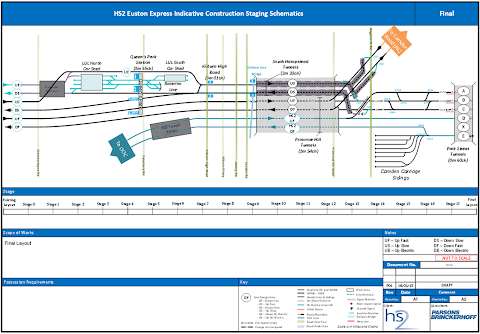
The Petition proposal, known as the 'Euston Express' scheme, suggests that HS2 should run on surface from Queens Park / Kilburn High Road to Euston Station. The petition contends that this proposal will result in a minimal increase in journey time and be cheaper and less disruptive compared with the Hybrid Bill scheme.
A review of the petition proposal has been carried out by C221 with input from C241 and C251. The review has only been carried out on the proposed petitioner's scheme between and Old Oak Common (OOC) station and Park Street Tunnels and excludes any potential effects at Euston station and throat.
The operational review of the Petitioner’s proposal has identified:
...
- The proposed infrastructure between Queens Park and Euston cannot be operated with an acceptable degree of reliability or flexibility
- It could not accommodate the proposed 2026 WCML classic train services and there would be no capacity for future growth
- The increased length of the route would potentially add 1min to 1min 30secs to the timetabled journey time.
"... A high level capital cost comparison has been undertaken and it has been estimated that the petitioner’s proposal is in the region of £781m more expensive than the Hybrid Bill scheme.
"A comparison between the Euston Express proposal and the Hybrid Bill scheme was under taken using the HS2 sift criteria and the Hybrid Bill scheme remains the preferred scheme."

"Were the prominent roles played by GLA staff in the promotional materials for Car Giant's proposals for the Old Oak Common Mayoral Development Corporation sanctioned by the GLA, and does the Mayor feel that given the role the GLA will play in determining the scope and ambition of the development, and the ongoing concerns residents in the area are expressing, it was appropriate?"Written answer from the Mayor
"GLA and OPDC would be the determining authorities for any future Car Giant planning application. Given that Car Giant own around 20 hectares of land at Old Oak, you won't be surprised to hear that both authorities are working with this key landowner to ensure an acceptable planning application is submitted for determination. Both authorities and decision makers are also very aware of the process that needs to be followed, so as not to pre-determine any planning applications. GLA and OPDC are meeting with local residents to seek their input into planning policy and will consult local residents on any planning application."

 |
| Link to web site |
 |
| Parliamentary Under Secretary of State for Transport Robert Goodwill MP |
"My message to today’s (16 September 2015, Waldorf Hilton, Aldwych, London) conference is clear.
HS2 is happening, and it’s time to get ready.
The HS2 bill is making steady progress through the House of Commons.
And we are on track to receive Royal Assent by the end of 2016.
Before the election, we put HS2 in our manifesto as part of our plan to rebalance the economy.
To transform Britain’s infrastructure by creating new connectivity in the north.
To release much-needed capacity in the south.
To secure thousands of skilled apprenticeships and jobs across the country.
It was a vision backed by the electorate.
They gave us 5 clear years.
By which time this project will be well past the point of no return."
"Since May, we have wasted no time.
Over the summer we started recruiting for HS2’s design panel.
The team of designers who will help decide how HS2 will look and feel.
Lord Adonis joined HS2 Ltd’s board.
And last week we announced our plans for Euston, plans that will reduce disruption and allow us to turn the station into a thriving transport and community hub.
In the coming year, the HS2 bill is set to pass through the hybrid Bill committee and reach third reading.
And we will also announce how we will take forward HS2’s northern sections, from Birmingham to Manchester and Leeds.
So the debate about whether to build HS2 is over.
Now it’s time to discuss the detail of delivery.
And how cities should plan to benefit from the new HS2 network.
I am pleased to see these themes running through today’s conference.
Because those are the themes I want to talk about today."
"The progress we’ve made with the HS2 bill means that we are on course to start building in less than 2 years’ time.
We have a clear plan.
To go from managing the HS2 bill through Parliament, to managing the deployment of the thousands of infrastructure professionals along with all the materials and machinery we need to start building the line in 2017.
We are starting the procurement process by preparing the contracts that will be signed as soon as the bill has passed; some of the largest value contracts in UK construction history.
Generating tens of thousands of opportunities.
Sixty percent of which we expect to be awarded to small- and medium-sized businesses.
We need everything from architects to aggregates, steel and surveyors, to engineers and environmental consultants.
We estimate that HS2 will create 25,000 jobs during construction and 3,000 jobs when in operation.
Not just on site, but right across the UK.
Earlier in the summer, HS2 Ltd visited Wales to engage Welsh firms interested in opportunities on HS2.
Last week, HS2 was in Northern Ireland.
And in coming weeks they will visit Scotland."
"The jobs that HS2 will create are an incredible opportunity for the UK, but also a major challenge.
Because while we need 25,000 skilled professionals for HS2, our investment in the existing rail and road networks is creating another 20,000 jobs.
And that’s at the same time as we need skilled people for all our other great infrastructure projects such as flood defences, nuclear power stations and perhaps even Crossrail 2.
We need many more engineers, surveyors, construction workers, planners, drainage experts and even arboriculturists.
So we are getting ready now.
We will write into the statute book our commitment to create 3 million apprenticeships by 2020, many of which will serve infrastructure.
And we are supporting specialised colleges.
The Crossrail Tunnelling Academy has enrolled over 10,000 students since opening in 2012.
This autumn the National Training Academy for Rail will open in Northampton.
And in 2017, we will open the National College for High Speed Rail.
Together, these institutions will form a national network of transport infrastructure skills academies to train the transport workers of the future.
That is how we will get to the point of construction for HS2."
"But getting construction under-way is just the beginning.
We need to plan for day the line is open.
And how it will transform travel between our cities, as well as transforming the locations it serves.
Take Old Oak Common.
A place that hasn’t received the same attention as Euston or Birmingham’s Curzon Street – yet.
But a place to which HS2 will bring profound change.
Old Oak Common is 155 acres of brownfield and industrial land in north-west London.
It is larger than Canary Wharf or the Olympic Park.
And under our plans for HS2, it will be home to one of Britain’s most important transport hubs.
With a station served not just by HS2, but also Crossrail, the Heathrow Express, and trains serving the west of England and South Wales on the Great Western Main Line.
It will be used by up to a quarter of a million passengers every day, providing much-faster connections between Birmingham and Heathrow, Stratford and London’s West End.
In fact, we estimate that one third of HS2 passengers will use Old Oak Common as their connection hub rather than Euston.
We know the power of transport to regenerate communities.
We have seen it at Kings Cross and around many of the high speed stations in France.
And now we are about to see it at Old Oak Common.
In April, the Mayor of London set up a Development Corporation to ensure we seize this opportunity.
If we get it right, our plans for the area could provide 55,000 jobs and 24,000 new homes.
It will turn Old Oak Common into a destination every bit as important as Euston, Paddington, Kings Cross or Birmingham New Street."
"Those are just a few examples of how we are getting ready for HS2.
Procurement, training and local planning.
Themes that you will cover in much more detail throughout today.
And that’s why we welcome conferences like today’s.
This is an opportunity for our national experts to debate best practice, to learn from the past and from one another.
In the next few years we will need that expertise, as we follow in the footsteps of our Victorian forebears, and build HS2.
Thank you."


